Tuesday, August 11, 2009

Sticky or stuck?

Source: Pharma Focus
Written by: Emma D'Arcy

How the industry can overcome its reservations of social networking and forge new more open online relations with doctors.

The 60's philosopher and communications guru Marshall McLuhan said, "the medium is the message" and certainly the current buzz around social media could lead you to conclude this new medium will soon overshadow all other media.

The pharma industry is currently conspicuously absent from online conversations about health and medicines. Web 2.0 and social networking have seen new sites and interactive discussions spring up everywhere on the web, but few pharma companies have a voice.

Except for a few companies (Pfizer 'eavesdropping' into www.sermo.com, GSK 'corporate-talking' through its 'More than Medicine' blog and several companies using Twitter for corporate and employee communications) the industry is lagging in the endeavour to truly innovate its interactions with the medical community, particularly via social media.

Can social media improve relations with physicians?

The term 'social media' under the umbrella of web 2.0 technologies originated as customer support, using surveys, polls, focus groups, online forums and discussion groups to garner feedback on products. Today's social media tools (blogs, networks, wikis, podcasts, RSS and now tweets) all contribute to the user-generated opinion and peer-to-peer online conversations.

Social networks are communities in which individuals are connected through values, working relationships, ideas and friendships. To enter into such online conversations, companies must engage in genuine information exchange rather than data-dump, so that both parties benefit from the relationship. Accordingly, as trust builds through active listening and sharing, loyalty develops which leads to a more lasting and meaningful relationship. This is known as 'stickyness' in web 2.0 vernacular.

For the pharmaceutical industry this offers a remarkable chance to interact with physicians and patients.

Against a tirade of allegations about undue influence, unnecessary spending and inappropriate relationships with its customers, industry can start to use more on the power of social networking and social media to align more transparently with these groups. However, this paradigm-shift in communication is an alarming conceptual challenge to pharmaceutical companies who, as the most heavily-governed industry, have always had to be careful about accuracy of the dissemination of information about their products, pipelines and objectives.

The value that social media offers to companies, and the opportunity to revolutionise and elevate physician-industry interactions to an equal, collaborative footing could be lost if industry cannot see past its own fears and stigmas surrounding web/health/physician 2.0. Whichever term you prefer - the majority of industry is stuck in the read-only internet.

Overcoming inhibitions

To capitalise on social networking industry must overcome its inhibitions about social media, which are rooted in a fear of litigation, and an environment that lacks formal guidance and protocol. So far, the self-governing trade associations have been evasive about the governance of social media, hence companies opt to not engage in the new media.

From a communications and PR perspective, the desire to dismiss social media is understandable because it is forcing a fundamental shift in mindset. The industry still has to be persuaded that moving from formal, periodic, outbound 'broadcasts' to real-time and direct 'participation' is not science-fiction but medical-science fact. Less secrecy about your product, people and company is compelling and humanising - it offers the chance to end the 'pharma is the big bad wolf' story.

Given that there are approximately 260,000 doctors on Sermo and more than 120,000 physicians using docnetworking.co.uk, it is evident that stakeholders are willing to engage in this way using this medium. If industry's voice remains notably absent, however, it is likely that scepticism will surface. Industry will be chastised for deliberately choosing not to participate. If incorrect information is posted about a product for example and a choice is made to ignore it or not correct it, the interpretation (fair or unfair) may be perceived to be the moral equivalent of not coming to the aid of a person in trouble. It is in industry's best interest to register that social media is more than a passing-trend; it is the principle way in which physicians and patients want to communicate already. Like it or loathe it, the Facebook/Twitter/Bebo generation are super multi-taskers who consume 20 hours worth of multi-media streams in only a seven hour real-time every day. And this choice of interaction is not limited to teenagers, nor is it the lonely pursuit of the stereotyped computer-geek; the most recent Manhattan Research survey of US trends revealed that 'those with a voice online tend to be older, with much professional experience and something to say.'

Social media calls for experimental participation

There are already a plethora of blogs and physician-physician and patient networks that have appeared to radically alter the patient-physician-pharma communication triangle. The absence of the industry in these online conversations is remarkable. There are at least five times more patient-originated social media sites than there are ones prepared by or directly for industry. Also unusual is the lack of a 'place' for the industry to engage directly with the medical community with equality; although there are several sites for healthcare professionals.

Online marketing has clear potential in simple business terms, too. The ROI from traditional marketing channels is declining and the colossal spend on doctor-detailing via the sales force is no longer acceptable to patients or to the public. Relationships with doctors, however, will remain pharma's main conduit for dissemination of product data and companies would be wise to participate directly and pioneer the value in social networking opportunities.

Such enlightenment is hard to find, however. Traditional medical education communication companies (MECC) are keen to help their pharmaceutical clients map their journey to this promise of 'open relationship nirvana' through social media applications (and specialist digital groups are trying to work with MECCs to become visible to pharma), but more often than not their creativity gets quashed by the fear of industry to wade into unchartered territory. Richard Evans, managing director of DarwinGrey says: "The pharmaceutical industry is slower to use social media compared with other sectors because of part-perceived and part-real regulatory hurdles and the operational complexities of where exactly a social media strategy should be managed and with which external agency experts. A mix of corporate affairs, legal, regulatory and eStrategy expertise will drive the adoption of social media internally because ultimately it will be the company's reputation that is open to dissection.

"As such, when social media credentials and capabilities are discussed, we are never surprised that while clients are familiar with the concepts the freedom to pursue far reaching plans is often not yet in place - but it is changing."

David Moore, vice-president eMedFusion, KnowledgePoint360, provides another insight into why his agency's pharma clients can seem shy to engage. He suggests there is scepticism surrounding the translation from a personal origin to a professional application of the approach: "The stigma of this being associated with an adolescent Facebook/pop music superficiality is difficult to shake off [and] that social media are in-vogue but lack depth which is completely alien to the clinical-trial/data-demand culture that pharma are required to operate in".

This echoes one of the common criticisms levelled at social media - inaccuracy - which accompanies general concern about a sense of 'loss of control' of content in online conversations. The simple counterpoint to this is one of participation and proven statesman-like behaviour - with social media there are potentially millions of voluntary contributors, editors and fact-checkers who are compelled to substantiate, ratify and corroborate.

And online communities do not tolerate miscreant attempts to destroy, hijack or pollute the e-environment in which they invest such personal capital. Hence the manifest 'stickyness' of loyalty through a trusted experience. Wikipedia for example, is the benchmark of this segue from random opinion to respectable information around citizen journalism - it has been validated to be as accurate as Encyclopedia Britannica with four times the volume of information. Content is continuously submitted and scrutinised by a global cadre of experts who are committed to conserving its value. While this may seem spontaneous, it is actually a highly-ordered mechanism with the ability to self-regulate and correct rapidly.

For those who lament that social media may signal extinction of the peer-review process, the opposite is the reality: social media represents the chance to see the process evolve by assigning 'the wisdom of the crowds' approach. Clearly the opportunities must be explored, investigated and fine-tuned, but as Len Starnes, head of European e-Business at Bayer Schering stated in 2007, "Connecting in more interactive ways can be incredibly powerful. Enabling individuals is what's its all about and that's something we haven't had before. It's really about getting individuals to participate."

Pharma needs third parties to inspire confident engagement

Ironically, the pharma industry, which accommodates such prestigious pioneers of medical science, needs to experiment more with social media and harness the potential benefits for users and the industry. Malcolm Allison at Actelion Pharmaceuticals summarises the approach by most companies, explaining that, "We are still working out how to get involved and most efforts we have seen so far have been clumsy. We are observing the utility of social media to increase transparency of interactions with stakeholders - trying to guage if it is possible or viable to get more use out of these media without our involvement or the contribution becoming distorted."

Despite this caution, industry recognises much can be achieved with social media. Malcolm echoes many of his peers in industry when he notes: "Although we are exploring slowly - and there is no policy in place yet, we are able to use information gleaned from social postings, to lead discussions and develop closer working relationships with physicians. [It] does give us insights into the disease community, especially when we venture into new areas. It can jumpstart our understanding, and provide hooks to elaborate on in discussion. It can also help us to frame questions, and more rapidly gain the confidence of KOLs."

The voice of such pioneers is finally gathering momentum and companies are starting to believe that the hurdles of using social media can be overcome by working with third parties who are leading social media projects such as www.myphid.com - a professional networking hub established to promote and encourage interactions of merit between industry and healthcare professionals.

I co-founded myPHID to activate collective and personal clinical and commercial aspirations - to act as both provoker and mediator so that community members are able to talk transparently about medicine not marketing, align with peers, share goals and passions about medical science and make a difference to how relationships in healthcare are established, perceived and valued.

As an experiment in the value of social media, myPHID (scheduled to launch its interactive phase in September 2009) is already proving that industry can harness these tools to claw back the credibility it deserves for the way it wants to improve relations with physicians on an equal footing.

Evidently, we are witnessing a shift from traditional forms of information-sharing within the profession and business of medical science. Social media hold the potential to change interactions from being one-on-one relationship to a multi-faceted network with multiple layers of interactivity. These new avenues provide the opportunity for industry to break down the distrust that shrouds their current modes of activities.

If pharma can be persuaded to be sticky with social media rather than stuck in their outdated practices with physicians, there is scope to behave better and with corporate confidence about such important collaborations.

Emma D'Arcy is founder and leader of scientific insights at MyPHID: emmad@myphid.com A one-day conference on pharma-clinician relationships, ACTIVATE 09, will be held on 8 September. Visit: www.activate09.co.uk for more information.

buzz this

From Twitter 08-10-2009


Tweets copied by twittinesis.com


buzz this

Monday, August 10, 2009

Special Report: "Where We Stand: Social Media, Pharma, and the Online Discussion"

Source: HC Marketplace

Click here to read more and order a copy of the report.

ePharmaceuticals' special report, Where We Stand: Social Media, Pharma, and the Online Discussion takes an in-depth look at the different ways pharmaceutical companies can engage in social media, the most common pitfalls and roadblocks, and innovative partnerships. There's also a discussion with PatientsLikeMe and biopharma UCB, which are partnering to create an online patient community, complete with a pharmacovigilance platform.

Where We Stand: Social Media, Pharma, and the Online Discussion will help you:

  • Learn where to start when exploring social media and what you should be doing now
  • Assess the pros and cons of branded versus unbranded efforts
  • Understand the real implications of adverse events on social media
  • Discover tailored ways to listen to consumers
  • Define social media, not just in a basic way, but within your own company’s priorities
  • Uncover missed opportunities
The report features commentary and advice from experts at:
  • PatientsLikeMe
  • UCB
  • Google
  • WebMD
  • Nielsen Online
  • Pew Internet & American Life Project
  • Bridge Worldwide
  • Ignite Health
For pharma, the social media question is no longer "whether" they should invest, but "how." Where We Stand: Social Media, Pharma, and the Online Discussion will help answer that question.

Click here to read more and order a copy of the report.
buzz this

TransforMED Launches First-Ever Professional Social Networking Site For Primary Care Physicians, Physician Extenders and Office Staff

Delta-Exchange aims to help medical practices and residency programs transform to the patient-centered medical home model of care

LEAWOOD, Kan. – TransforMED LLC, a wholly-owned subsidiary of the American Academy of Family Physicians, today announced the launch of Delta-Exchange, a first-of-its-kind collaborative networking site dedicated to helping primary care practices implement the patient-centered medical home model of care.

Delta-Exchange was created when key findings from TransforMED’s two-year medical home national demonstration project revealed that primary care practices want and need opportunities to communicate, collaborate, and learn from other practices as they seek to overcome the challenges of implementing new technologies and workflows that are key to PCMH transformation. Delta-Exchange addresses these needs in an online, social networking platform.

“The NDP taught us that many primary care practices feel isolated, and many practice leaders are reluctant or unable to hire a consultant to help them transform to a patient-centered medical home,” said Terry McGeeney, M.D., MBA, president and CEO of TransforMED. “TransforMED now offers Delta-Exchange as an alternative means for practice leaders, doctors and other office staff to access useful information and collaborate with peers to learn best practices as they seek to adopt this new model of care.”

Delta-Exchange is quickly becoming a robust repository of tools, resources, case studies and practical how-to articles on practice transformation topics such as implementing team-based care, reducing patient cycle times, change management and maximizing office space. The site also hosts regularly scheduled, live webinars on a variety of PCMH and practice improvement topics ranging from optimized billing and collection to implementing open-access scheduling. Participants can interact in live sessions or view archived webinars on-demand. Members can also download workflow and procedure forms that can be customized to individual practices.

Delta-Exchange offers a host of individual member benefits. For $30 a month per user, members can create their own profile, post documents, share images and videos, create wiki pages and engage in discussions with other members. Members also gain access to optional, private work zones for physicians, clinical staff, office staff and others.

“To encourage candid discussions among members, some zones require an invitation to participate,” McGeeney explained. “For example, office managers are not allowed access to the physician’s zone, and vice versa. However, all Delta-Exchange members have access to TransforMED’s highly experienced practice facilitators via the ‘Ask the Experts’ zone.”

Delta-Exchange also provides member subscribers with “watchlists” that enable them to monitor discussions among colleagues, experts and innovators. Members will also receive TransforMED’s informative online newsletter and e-mail updates. The site comes complete with help files and video demonstrations on how to make the most of their Delta-Exchange membership.

Delta-Exchange is exclusively for primary care practices. Members will not encounter vendors or sales pitches on the site.

“As the patient-centered medical home model of care continues to emerge as a viable solution in health care reform legislation, we encourage primary care physicians to begin taking steps toward patient-centered medical home transformation,” McGeeney said. “Delta-Exchange serves as an excellent starting point.”

buzz this

Saturday, August 08, 2009

From Twitter 08-07-2009


Tweets copied by twittinesis.com


buzz this

Friday, August 07, 2009

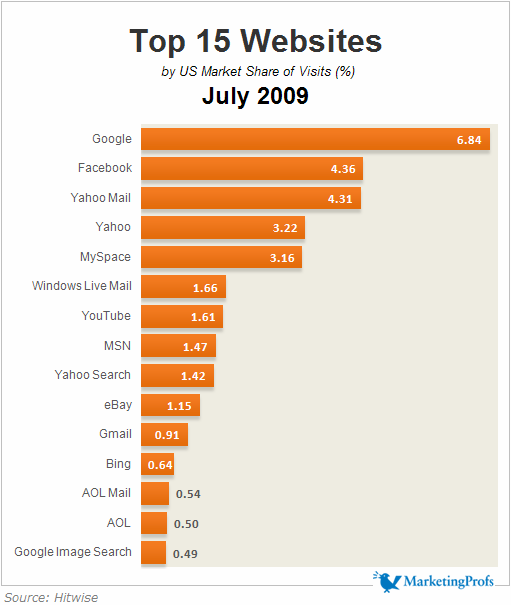
Hitwise: Top 15 US Websites, July 2009

The Hitwise data featured here (Top 15 US Websites, July 2009) is based on US market share of visits, as defined by the IAB—the percentage of online traffic to the domain or category—from the Hitwise sample of 10 million US Internet users.

Hitwise measures more than 1 million unique websites daily, including sub-domains of larger websites. It categorizes websites into industries on the basis of subject matter and content, as well as market orientation and the competitive context.

The market-share-of-visits percentage of certain websites does not include traffic for all sub-domains that could be reported on separately.

buzz this

From Twitter 08-06-2009


  • 10:10:19: RT @manhattanresear: "New eHealth Trends podcast: The FDA & Pharma Search Engine Marketing": http://tr.im/vL5N
  • 22:06:13: Well, well. hre we R. U have exactly 8 hrs & fifty-four mins 2 think abt y U're hre. U may not talk, U will not move from ths seats. Any ??s


Tweets copied by twittinesis.com


buzz this

Thursday, August 06, 2009

From Twitter 08-05-2009


  • 11:32:48: Paid search? New FDA guidenlines? Download the whitepaper: "Yes We Can: Time for an FDA Internet Drug Advertising Policy": http://tr.im/vvEQ
  • 13:40:35: "DTC Implications: FDA Calls Foul on Magic Johnson Promotional DVD" (via Arnold Friede from RPM Report): http://tr.im/vDav


Tweets copied by twittinesis.com


buzz this

Wednesday, August 05, 2009

DTC Implications: FDA Calls Foul on Magic Johnson Promotional DVD

Written by Arnold I. Friede

Source: The RPM Report
July 2009, Vol. 4, No. 7
(posted with permission of author)

FDA’s criticisms of promotional DVD for Abbott’s Kaletra highlight pitfalls of celebrity testimonials. FDA says too much of the session with the basketball star focuses on benefits from drug; risk information is just an afterthought. The interview with net star also demonstrates FDA concept of inaccurate “net impression.” The DVD creates implied claim that drug works for five years – without supporting data.

On July 14, the Division of Drug Marketing, Advertising, and Communications (DDMAC) in FDA’s Center for Drug Evaluation and Research issued a Warning Letter about a promotional DVD featuring an interview with basketball great Earvin “Magic” Johnson about his personal experience with the combination protease inhibitor AIDS drug, Kaletra (lopinavir and ritonavir).

This compliance correspondence offers immediate insight into how a few of the concepts articulated by the agency in its May 2009 Draft Guidance for Industry: Presenting Risk Information in Prescription Drug and Medical Device Promotion will be applied in practice.

In this context, perhaps the most important aspect of the Warning Letter has to do with the substantial criticism by the agency of where and when in the promotional DVD the key risk information appears.

According to DDMAC, “the first 11[and 1/2] minutes of the promotional DVD are devoted to an engaging and lively discussion…presented in an interview format…that includes a discussion of the benefits Magic Johnson has received from Kaletra.” However, “in contrast, the presentation of serious risks associated with Kaletra is relegated to the end of the DVD after the interview is over, where it is unlikely to draw the viewer’s attention.”

FDA says “this overall presentation misleadingly minimizes the serious risks associated with Kaletra because it fails to convey the important risk information with a prominence and readability reasonably comparable to the claims of effectiveness.”

Putting aside for the moment the underlying concerns about the importance in context of the specific information about the drug’s serious risks, the temporal delay between communication of the benefit information in the promotional DVD and the information about serious risks was in and of itself particularly troublesome to FDA. In this respect, DDMAC appears to be articulating a principle that might be termed “tight integration” of risk with benefit information.

As the agency said in the draft guidance: “In addition to appearing with or near benefit presentations, risk information should appear as an integral part of the piece, just as benefit information does.”

One might question how the principle of “tight integration” might be applied where the temporal delay between the benefit and risk information is substantially less than the 11 and 1/2 minute delay in the Magic Johnson promotional DVD—say, for example in the context of a 60 second television commercial. At the same time, however, deviation from that principle, at least as perceived by DDMAC, is a major aspect of this Warning Letter.

A second key lesson from FDA’s letter has to do with whether, to what extent and how testimonial claims can be generalized to a broader target audience consistent with the “net impression” standard for evaluating the meaning of advertising as articulated in the draft guidance.

Magic Johnson is perhaps the best known example of the role and value of chemotherapeutic management of AIDS through aggressive use of anti-retroviral agents. He is an almost perfect embodiment of how these medicines have helped many people with the disease lead a relatively “normal life”.

We can all recall a time when these drugs were not generally available in the United States, and the ravages of the disease without them. At the same time, FDA has an institutional concern, grounded in the statutory “substantial evidence” standard, about basing promotional claims on one person’s experience, or even the experience of a small group, and then extrapolating from there to a broader population.

In this context , one can certainly comprehend the concern that the “net impression”—although the term is not used explicitly in the letter—from the Magic Johnson interview is the claim that Kaletra would be effective for at least five years and allow someone to lead an absolutely “normal life” except for having to take medication.

This concern was intensified because, ironically, almost precisely five years ago (on October 29, 2004), DDMAC issued an untitled letter about implied claims “that patients taking Kaletra can expect to survive and be healthy for at least five years, in the absence of substantial evidence or substantial clinical experience to support such an implication.”

This overall net impression was not alleviated, according to FDA, by the use in a “super” of the qualifier “individual results may vary”. This interpretation is consistent with the tenor of the draft guidance, which repeatedly emphasizes the limitations of qualifying information in a variety of contexts.

In the end, the draft guidance provides a useful prism for discerning some of the generalizable principles in FDA’s Warning Letter on Kaletra and the Magic Johnson DVD. It should likewise provide a useful framework for both going-forward and retrospective analysis of other DDMAC compliance correspondence.

buzz this

A New “BLACKBAG” for Physicians

by Melissa Waggenspack
Original post: JNJBTW

You may have noticed your physician using a PDA or smartphone during your last visit to the doctor’s office. According to a report by Manhattan Research, this trend is on the rise in 2009, with approximately 64 percent of U.S. physicians using a PDA or smartphone to stay connected while on-the-go.

Ortho-McNeil-Janssen Pharmaceuticals, Inc observed this increase in the number of health care professionals using mobile technologies and created the BLACKBAG™ iPhone Application, which gives physicians access to the latest medical information at their fingertips. Within the first two months of launching the app, BLACKBAG was downloaded by approximately 24,000 users.

The idea behind the BLACKBAG app was to provide physicians, pharmacists, nurses, and other health care professionals with easy access to resources and tools to help them stay informed; an electronic version of a doctor’s “black bag.” The app contains unbranded content across a number of medical areas and specialties. Health care professionals can subscribe to customized news feeds to receive breaking medical news, and access to journal summaries, conference coverage, videos and podcasts related to their areas of interest.

buzz this

From Twitter 08-04-2009


  • 13:38:33: Just had my 1st vid conference on a commercial jet / via Skype. Client was talking, I remained silent & gestured/used chat. By choice.
  • 14:29:48: WORTH WATCHING: "Ben Stiller is Online". Video of Stiller (@RedHourBen) using social media: http://tr.im/vtCv (via @mashable)
  • 19:19:55: Thoughts on how this applies 2 "FDA's 14 Letters 2 Pharma"? MediaPost "Onerous Regs 4 Web Ads Ruled Unconstitutional": http://tr.im/vvs9
  • 19:20:57: NICE! RT @jonmrich: No, Pharma's Digital Future Isn't All Social Media. Check out article in AdAge's DigitalNext: http://bit.ly/nlr2a
  • 19:22:23: Glad u guys all met! Beer Summit? RT @ambremorley: Nice meeting @pharmaguy today with Charlie http://bit.ly/kjIAH
  • 19:53:08: Download the new whitepaper: "Yes We Can: Time for an FDA Internet Drug Advertising Policy": http://tr.im/vvEQ
  • 20:32:15: LOL! RT @jonmrich: @SonofaMack & other bloggers 2. I feel sry 4 U, son. Shall I call the authorities 2 rescue U? Tweet once 4 yes, 2 4 no.
  • 20:59:45: RT @nicolejohnson @bmaldonado: ADAGE: Marketers shifting budget funds from traditional media to social media: http://tr.im/vw2X
  • 21:04:14: If only Mary wld leave SoUThnkUCnDnce I wld B complete! RT @mashable: Paula Abdul Tweets That She's Leaving American Idol: http://tr.im/vw5o
  • 21:05:21: RT @michaelgass: New Research: Marketers are finally moving into social media along with budgets http://snipr.com/kpkjh
  • 21:20:24: DO U AGREE? eMarketer's KEY TAKEAWAY in recent survey: w/out broader consumer acceptance, TWTTR will b poor markting tool: http://tr.im/vw9g


Tweets copied by twittinesis.com


buzz this

Tuesday, August 04, 2009

Who Finds Twitter More Effective, Advertisers or Consumers?

Source: eMarketer
AUGUST 4, 2009

Consumer awareness remains low.

Though Twitter is currently a media darling, only 8% of advertisers and consumers think it is a “very effective” promotion tool, according to June 2009 data from LinkedIn Research Network and Harris Interactive.

The research, which included surveys of US advertisers and Internet users, found that while 83% of advertisers were familiar with Twitter, only 31% of Web users were.

Naturally, younger respondents were more familiar with the microblogging site. Only 11% of 18-to-39-year-old advertisers did not know enough about Twitter to have an opinion on its value, compared with 20% of advertisers ages 40 to 49 and 21% of those 50 and older.

Among Internet users, 55% of 18-to-34-year-olds said they were not familiar enough to have an opinion, compared with 80% of those 55 and older.

In terms of Twitter’s effectiveness for promoting products and ideas, both advertisers and consumers were tepid.

In addition to the 8% of advertisers who said Twitter was very effective for promotion, 50% said it was somewhat effective. More than three in 10 (34%) said it was not very effective and 8% felt it was not effective at all.


Among consumers, 8% said it was very effective, 42% believed it to be somewhat effective, 31% said it was not very effective and 19% felt it was not at all effective.

The takeaway: While marketers, advertisers and members of the media have jumped on the Twitter bandwagon, the average US consumer has not. And without broader consumer acceptance—not to mention awareness—it can’t be considered an effective marketing tool.

If this never happens, all the tweets in the world won’t make much difference.

buzz this

More Marketers Use Social Media, Survey Says

55 percent said they shifted funds from traditional media to execute social media campaigns

By Steve McClellan
Source: Ad Week

NEW YORK Social media has gained significant traction this year as a marketing tool, according to a new survey from the Association of National Advertisers, BtoB Magazine and marketing services firm Mktg.

The study found that 66 percent of marketers have used social media in 2009, compared to 20 percent in 2007. Fifty percent have employed viral videos so far this year, up from only 25 percent in 2007.

The survey was conducted online in June and is based on responses from 172 client-side marketers.

Facebook was the most popular venue, with 74 percent of respondents saying they used the site for marketing purposes. YouTube and Twitter followed with 65 percent each, and LinkedIn tallied 60 percent, according to the study.

Search engine marketing was cited as the most effective new-media platform by 65 percent of respondents, while 59 percent cited their own Web sites. Search engine optimization was selected by 55 percent, while 45 percent chose e-mail marketing. Company-owned Web sites will get most of the money earmarked for new-media platforms, according to 26 percent of the respondents, while 19 percent said search-engine marketing would get the biggest share and 17 percent said it would go to online advertising.

More than half of the respondents (55 percent) said they shifted funds from traditional media budgets to execute social media campaigns, while 48 percent said they took money from marketing communications budgets. Twenty-six percent said they created an incremental budget.

The top concerns for marketers when considering newer media platforms are the inability to prove ROI (45 percent) and a lack of metrics to properly allocate the mix of traditional and digital media (43 percent).

Commenting on the results in a statement, ANA president and CEO Bob Liodice said: "As more media platforms become available, it is imperative that all marketers continue to assess their capabilities and select the platforms that are best suited to help them meet their brand's goals and objectives. With this proliferation of media, marketers must work harder, survey the entire landscape available to them and create their brand's most optimal media mix."

The study also revealed differences in the ways business-to-business and business-to-consumer marketers use new media platforms. While mobile is used by 32 percent of overall marketers, it is three times more likely to be used by b-to-c marketers. LinkedIn rates first with b-to-b marketers while Facebook is top among b-to-c marketers.

Twitter is used more by b-to-b marketers (70 percent) than b-to-c marketers (46 percent). B-to-c marketers see more effectiveness from SEM (76 percent) than b-to-b marketers (48 percent).

In the next year, blogs are expected to be the hottest new marketing channel, according to 34 percent of the respondents not already using the platform, while 28 percent cited mobile and 23 percent cited social media.

buzz this

Yes We Can: Time for an FDA Internet Drug Advertising Policy

Download the paper by Arnold I. Friede and Robert B. Nicholas

"Hopefully, DDMAC’s preemptive war on sponsored links, and its unequivocal rejection of the “one click” rule that industry had long assumed was applicable in this context, does not refl ect the Obama Administration’s long-term intention to continue to apply to manufacturer Internet communications the same regulatory regime that FDA applies to traditional print labeling and advertising."

Click on the image below to download the full article.

buzz this

Onerous Regs For Web Ads Ruled Unconstitutional

Source: Media Post Blog
by Wendy Davis

"Internet advertising differs significantly from advertising in traditional media." That's according to U.S. District Court Judge Martin Feldman in Louisiana, who Monday invalidated portions of new state restrictions on attorney advertising.

The new rules would have required lawyers to submit all ads, including pay-per-click search ads, to a committee for advance review at a cost of $175 per ad. If blog posts were deemed ads, attorneys could have had to pay for vetting each time they made a new post.

The law firm that challenged the new regulation, the Wolfe Group, said that it spent $160.63 on pay-per-click ads with Google in the second quarter. During that time, the firm ran 12 variations of its ad. The cost to the firm of vetting those ads could have been as high as $2,100.

Feldman found that such limits on Web advertising were unconstitutional. In his 39-page opinion, he also criticized the authorities for crafting an ad policy that didn't account for the difference between push and pull mediums. "The Internet presents unique issues related to advertising, which the state simply failed to consider in formulating this rule," he wrote.

This decision makes a lot of sense. Like other types of advertising, pay-per-click ads can mislead consumers. But that's no reason to require marketers to present their ad copy for pre-publication review -- a process that would certainly discourage many legitimate companies from using the Web to communicate with consumers.

buzz this

From Twitter 08-03-2009


  • 18:07:06: From "United Breaks Guitars" to "Motrin Moms", here are @roncallari's "Top Ten Branded Social Media Nightmares": http://tr.im/vmXk


Tweets copied by twittinesis.com


buzz this

Monday, August 03, 2009

inVentiv Health Expands Into Japan

SOMERSET, N.J., Aug. 3, 2009 (GLOBE NEWSWIRE) -- inVentiv Health (Nasdaq:VTIV - News), a leading provider of commercialization services to the global pharmaceutical and healthcare industries, announced today it has established inVentiv Japan, a Tokyo-based operation that will provide commercialization services to healthcare clients.

"Japan is among the largest pharmaceutical markets in the world and our clients are launching many products into the Japanese market," said Blane Walter, Chief Executive Officer of inVentiv Health, Inc. "Establishing inVentiv Japan will enable us to fulfill our clients' needs, while also supporting inVentiv's growth as a global healthcare leader."

inVentiv Japan will provide outsourced sales solutions through the company's Selling Solutions division. inVentiv currently has agreements with four top 20 pharmaceutical companies and a Japanese specialty pharmaceutical manufacturer to provide sales teams that will promote several of their products in Japan.

Japan was a $76.6 billion market for pharmaceutical sales in 2008, with expected growth of 4-5% in 2009, according to IMS data. The market is comprised of approximately 56,000 pharmaceutical sales representatives, but only about 4% are currently outsourced.

"We believe there is significant opportunity for outsourced sales growth in Japan," said Terry Herring, President and COO of inVentiv Health, Inc. "Not only have many top-selling U.S. pharmaceutical products not yet launched in Japan, but a growing number of pharmaceutical companies in Japan are looking to increase the flexibility of their workforce. We have been extremely pleased by the initial response to our offering over the past quarter, and we are excited by the opportunity to build additional client relationships in this expanding market."

inVentiv's sales operation in Japan is led by Dan Feldman. Mr. Feldman has more than 20 years of senior management experience in marketing and sales of ethical and over-the-counter pharmaceutical products, and in the delivery of outsourced services in Japan, Asia, and Australia. Prior to joining inVentiv, he served as Vice President of Sales at Merck-Banyu in Japan, and held several senior-level positions with pharmaceutical service providers in Japan and Korea. Mr. Feldman also previously founded Churchill Communications, the first healthcare communications firm in Japan.

"Dan Feldman is the ideal person to lead our sales operation in Japan. His experience managing pharmaceutical commercialization efforts in Japan and throughout Asia is unparalleled. Also, having worked for both pharmaceutical manufacturers and service providers, he brings valuable perspectives on the needs of our clients," said Thomas Dimke, Senior Vice President, overseeing international efforts for inVentiv Selling Solutions.

In addition to its Selling Solutions offering, inVentiv Health also has Communications capabilities in Japan through an affiliate relationship with Ad-comm Group, a privately-held network of specialized communications companies in Japan.

About inVentiv Health

inVentiv Health, Inc. (Nasdaq:VTIV - News) is an insights-driven global healthcare leader that provides dynamic solutions to deliver customer and patient success. inVentiv delivers its customized clinical, sales, marketing and communications solutions through its four core business segments: inVentiv Clinical, inVentiv Communications, inVentiv Commercial, and inVentiv Patient Outcomes. inVentiv Health's client roster is comprised of more than 350 leading pharmaceutical, biotech, life sciences and healthcare payor companies, including all top 20 global pharmaceutical manufacturers. For more information, visit www.inventivhealth.com.

The inVentiv Health, Inc. logo is available at http://www.globenewswire.com/newsroom/prs/?pkgid=4942

This press release contains forward-looking statements within the meaning of the Private Securities Litigation Reform Act of 1995. Such forward-looking statements involve known and unknown risks that may cause inVentiv Health's performance to differ materially. Such risks include, without limitation: changes in trends in the pharmaceutical industry or in pharmaceutical outsourcing; our ability to compete successfully with other services in the market; our ability to maintain large client contracts or to enter into new contracts; and, our ability to operate successfully in new lines of business. Readers of this press release are referred to documents filed from time to time by inVentiv Health, Inc. with the Securities and Exchange Commission for further discussion of these and other factors.

 
buzz this

From Twitter 08-02-2009


Tweets copied by twittinesis.com


buzz this

Sunday, August 02, 2009

From Twitter 08-01-2009


  • 17:30:46: RT @DigitalBulldog New Pharma Twitter model: sponsor trusted content providers. Lilly Oncology sponsors @MedscapeOnc news from lung meeting
  • 17:39:35: @MaverickNY "@MedscapeOnc: IASLC World Conference on Lung Cancer, Day 2: Medscape Oncology news on Twitter sponsored by Lilly Oncology."
  • 17:45:01: @MaverickNY - interesting... Perhaps not all the tweets are sponsored ??
  • 18:03:01: @MaverickNY aha. Haven't taken the quiz. Boy, that's a lot of characters to use - "sponsored by lilly oncology"... :)
  • 18:19:09: RT @MaverickNY: Everyone's learning. But it's interesting - and actually provides value. http://twitpic.com/cggn6
  • 18:20:47: Medscape Oncology survey on use of twitter at World Lung conference. http://tr.im/v6J6
  • 18:27:26: WORTH THE READ - Fighting AIDS in Africa, The Future of Healthcare in Your Hand(set)-Via @BlippVert: http://tr.im/v6K8
  • 18:32:12: @shwen Happy anniversary. LOVE skydiving. One of the coolest things I've ever done.
  • 18:40:36: My entomologist brother just updated FB from Iceland: "The results so far: Spiders are predators". Anyone else find that creepy & cryptic?
  • 18:49:20: Cool! AMC launches "MADMEN YOURSELF" microsite 2 promote season 3. Build character, swap our your twitter/facebook avatar: http://tr.im/v6PQ
  • 18:57:29: Anyone remember "25 RANDOM THINGS", that facebook "note" that went hyper-viral? Check out this funny College Humor video: http://tr.im/v6Qu
  • 19:36:14: MySpace launches "MySpace Graveyard" in an effort to monetize lost members: http://tr.im/v71g


Tweets copied by twittinesis.com


buzz this

Saturday, August 01, 2009

From Twitter 07-31-2009


  • 07:34:28: RT @pharmaguy: Twitter for Rx Brands: An Experiment- Listen NOW 2 LIVE Pharma Marketing Talk interview of Kevin Kruse. http://is.gd/1VVgn
  • 07:37:45: Kevin explains the Pharma Twitter Experiment. VERY COOL. Great speaker 2! RT @kevinkruse: LIVE interview with @pharmaguy
  • 07:40:22: @kevinkruse 2 @pharmaguy re: Twitter Pharma Experiment: A "follow-back" on twitter is similar to an opt-in to a CRM program.
  • 07:42:30: @kevinkruse 2 @pharmaguy re: twttr Pharm Experiment: dnt include PI on profile page, but used brand name. probly wouldn't work in real world
  • 07:43:09: @kevinkruse 2 @pharmaguy re: Twitter Pharma Experiment: Full research results available at: http://tinyurl.com/mx94pp
  • 07:44:45: @kevinkruse 2 @pharmaguy ePatient2009 Conference: www.epatient2009.com use code = PMN15 for 15% discount - THANKS!
  • 07:47:00: QUESTION 4 @kevinkruse RE: TWITTER PHARMA EXPERIMENT: Did any of your 4 profiles ever tweet 2 the followers?
  • 07:48:55: QUESTION ON PHONE 4 @kevinkruse RE: TWITTER PHARMA EXPERIMENT: Did u buy domain name for fictitious product, and then check traffic?
  • 07:49:44: @kevinkruse response to question -- no, we didn't. But for our NEXT PHASE we have entire unbranded disease ed website (@pharmaguy)
  • 07:53:25: @pharmaguy @kevinkruse: How can we use twitter 4 brands in REAL world? #pharma
  • 07:53:51: @kevinkruse 2 @pharmaguy: Not sure discussing brand is really the best use of twitter for pharma.
  • 07:54:25: QUESTION 4 @kevinkruse RE: TWITTER PHARMA EXPERIMENT: Are you working with legal review team?
  • 07:55:06: @kevinkruse RESPONSE to legal review team question: NO. An experiment is never really "REAL WORLD".
  • 07:57:04: @kevinkruse & @pharmaguy : Great interview RE: PHARMA TWITTER EXPERIMENT.
  • 07:57:52: @kevinkruse & @pharmaguy : "FDA has absolutely dropped the ball in the case of providing guidance to the industry".
  • 07:59:15: @kevinkruse 2 @pharmaguy "...So in the meantime we'll have 2 cont 2 watch pioneering companies like Novo & efforts like @racewithinsulin"
  • 08:01:40: @pharmaguy: "Twitter, more than anything else, is putting pressure on the FDA to provide clear guidance on how 2 use these technologies".
  • 08:14:07: Lilly launches "Faculty Registry" site publicizing payments 2 doctors, demonstrates commitment 2 transparency: http://tr.im/uVuo
  • 08:15:16: @kevinkruse GREAT experiment - great interview - can't wait 2 see what you do next. Would love to chat about some ideas I have 4 u.
  • 13:05:30: VIDEO INTERVIEWS FROM EXL PHARMA: Google, FDA, Pfizer & Ogilvy share their POV on Healthcare comm, social media, & regs: http://tr.im/uY4y
  • 13:16:12: @Pharmaguy guest post on @DiabetesMine blog "What Diabetes Patients wnt frm the New Era of Pharma Mrkting". Answer: no BS. http://tr.im/uYa0
  • 13:24:25: INTERESTING. New Study indicates SOCIAL MEDIA pays; finds correlation between brands' SM efforts & financial performance: http://tr.im/uYgl
  • 13:32:27: This is SO cool - graphical representation of companies' social media engagement": http://tr.im/uYkJ
  • 13:44:21: RE: Top 10 Companies that engage via social media: I drink starbucks, own a dell, sell on ebay, search w/google, use MS office (cont'd)
  • 13:44:29: RE: Top 10 Companies that engage via social media: ... read reuters, wear Nike, buy on Amazon, Yahoo! is my homepage, & own BBerry (cont'd)
  • 13:44:38: RE: Top 10 Companies that engage via social media: BUT NEVER EVER EVER have read their blogs, tweets, or been to their facebook pages.
  • 14:36:34: TIPDROP: "Twitter + Wikipedia + Digg". Microblogging focused on ppl sharing tips w/ "credibility" engine: http://tr.im/uYQI THoughts?


Tweets copied by twittinesis.com


buzz this

Friday, July 31, 2009

Text Mining Provides Marketers With the 'Why' Behind Demand

Direct Shops Sift Through Social-Media Conversations to Explain Consumer Behavior Regarding Brands

Source: Ad Age

by Michael Bush
Published: July 27, 2009

NEW YORK (AdAge.com) -- Stephanie Hoppe, 7-Eleven's senior director-marketing, knew there was an incredibly competitive market for iced coffee. But before entering the battle by expanding its own product across its network of stores this past June, Ms. Hoppe and 7-Eleven needed to figure out the why that was driving consumer demand.

Enter text mining, a process in which an agency can mine the conversations taking place on blogs, Twitter or other social-media sites in order to identify the emotional aspects and reasons behind consumer behavior. Typical database information supplies marketers with the who, what, where, when and even the how, but not the why.

Using a tool called Digital Anthropology from Omnicom Group agency Rapp, Ms. Hoppe got a deep-dive analysis of what consumers were saying about why they drink iced coffee, what flavors they prefer, what presence its competitors had in the social space and what people were saying about their offerings.

"It's not in a focus-group setting so we were getting explicit and authentic data," Ms. Hoppe said. "It helped us create an effective campaign that was a little out of the norm for us in that it was sassy."

Megan Bannon, cultural anthropologist at Rapp, said text mining can't replace traditional data, but the combination of the quantitative and qualitative data they both offer creates a more holistic view of the consumer. In most cases there is no name connected to the data compiled from text mining or text analytics but that may soon change. "It's moving to the point where maybe we start collecting Twitter handles or user names on these sites and matching the exact CRM data to what this person is saying online," Ms. Bannon said.

'Delving into the conversation'
Text mining has shown her that people will discuss anything online. Before recently using the tool for a company pushing a "very intimate sexual product" Ms. Bannon said she wasn't sure she would find talk about it because of its personal nature. "You wouldn't believe the details and conversations," she said. "People were giving intimate details not realizing marketers are looking at it. They don't know that marketers are pulling back these key words and delving into the conversation."

WPP's Wunderman has its own text-mining tool called the Listening Platform, which it has used for a number of clients including Microsoft. Slavi Samardzija, senior VP-insights and optimization at Wunderman, said the agency has used it for research, identifying influencers, acquisition, micromessaging, microtargeting for CRM, structuring ad programs and product innovations as well as locating barriers to purchase. Wunderman clients using the Listening Platform get weekly reports highlighting key changes in language that are customized for the business groups most affected.

"We might find there's a quality-control issue, so the report will be distributed to the product development team or the quality team," he said.

Wunderman recently used it for a consumer electronics company that had issues launching a new product. Through mining online conversations the agency found "a key insight" and identified the barrier to adoption. "Consumers did not understand the benefits of the product and that inhibited purchase," Mr. Samardzija said. "We created messaging and execution designed to address this key dynamic."

Sid Banerjee, CEO of the 5-year-old Clarabridge, a customer experience management firm, said text analytics is starting to replace the focus group because it's cheaper and faster. Clarabridge collects data from three sources: survey responses, customer/representative interactions and social-media sites.

Mr. Banerjee said these data are significant in a recession because it helps you make sure you are cutting the right marketing dollars. "Being able to micromarket when you're marketing is important but being able to microcut is also important," he said. "You want to take a scalpel to your business, not an ax."

buzz this

Palio Launches Social Media Monitoring Tool

Source: Press Release

SARATOGA SPRINGS, NY, JULY 27, 2009—Palio, an inVentiv Health (NASDAQ: VTIV) company, launches a new tool to monitor social media for clients’ brands. Developed by Palio’s Research and Analytics team, Susurro [soo-sur-oh] is a social media-monitoring tool that provides a comprehensive understanding of online discussions surrounding clients’ brands. It focuses on consumer or patient online discussions of brands and competitors.

“When contemplating the need for this tool, we asked our clients a few questions: ‘Are you monitoring social media about your product?’ ‘Do you know what patients and physicians are saying about your product online?’ ‘Do you know where these discussions are taking place?’ ‘Do you know how patients and physicians react online to recent news about your product?’” said Carl Turner, vice president, research and analytics director at Palio. “Typically, the answer we heard was ‘No.’ We found that most clients need to know more of what is happening with their brand in social media. Basically, we found they are missing the rich information being shared about their product.”


Palio’s Research and Analytic team recognizes that the Internet is unfiltered. Conversations take place and information is shared without any control. “We want our clients to have a better awareness of how their brand is being discussed, so we developed Susurro,” said Turner. Susurro discovers and analyzes online product discussion across social media sources, including blogs, discussion boards/forums, pictures, videos and other user-generated content.

“Anyone can dig up information on the Internet and report on the number of references. It’s interpreting what is being said within the context of the brand that is important,” said Turner. Susurro provides an in-depth understanding of marketing messages and brand positions within the context of the brand. It is a market research tool that provides a qualitative and quantitative study of online discussion around a brand.

“Through this tool, we can provide clients with a qualitative analysis of relevant social media – a deep-content analysis of discovered media with excerpts and examples; natural reactions to events surrounding a product; underlying attitudes about a brand, medication or treatment; insights into the real lives of target patients; and a detailed qualitative breakdown of discussions by topic,” said Turner.

Susurro also captures misinformation shared about clients’ brands. “We also know that by using Susurro we can help predict and follow trends and market events.” For more information on how Susurro can help your brand, contact Carl Turner at 518.226.4120 or cturner@palio.com.

Palio is a full-spectrum advertising and communications agency headquartered in Saratoga Springs, NY, that excels in brand creation that changes the way people think with execution that will Never be forgotten.SM For more information on Palio, visit http://www.palio.com/.

####
About inVentiv Health inVentiv Health, Inc. (NASDAQ: VTIV) is an insights-driven global healthcare leader that provides dynamic solutions to deliver customer and patient success. inVentiv delivers its customized clinical, sales, marketing, and communications solutions through its four core business segments: inVentiv Clinical, inVentiv Communications, inVentiv Commercial, and inVentiv Patient Outcomes. inVentiv Health’s client roster is composed of more than 350 leading pharmaceutical, biotech, life sciences, and healthcare payor companies, including all top 20 global pharmaceutical manufacturers. For more information, visit http://www.inventivhealth.com/.
buzz this

Lilly Announces Continued Commitment to Transparency with Faculty Registry

New Web Site Publicizes Lilly's Payments to Health Care Professionals

Source: CNBC

INDIANAPOLIS, July 31, 2009 /PRNewswire-FirstCall via COMTEX News Network/ -- Today Eli Lilly and Company (NYSE: LLY) launched an online registry detailing recent payments it has made to physicians and other health care professionals - a report known as its "faculty registry." The data are for the first quarter of 2009; Lilly will update the registry quarterly going forward.

Lilly faculty are physicians and other health care professionals contracted to provide specific services on behalf of Lilly and the Lilly alliance partnerships. Faculty appearing in the registry either advised Lilly or conducted medical lectures designed for health care professionals and patient education. The site discloses each professional's name, location, description of the services provided and the compensation paid, among other details.

"This registry is consistent with Lilly's efforts to increase transparency," said Jack Harris, M.D., Lilly's vice president of its U.S. medical division. "We see greater transparency as integral to rebuilding trust in our industry."

Nearly 3,400 physicians and other health care professionals are in the dataset. The average payment per service provided is just over $1,000, with health care professionals conducting six activities on average. The data are available at www.lillyfacultyregistry.com.

"Our contracted faculty are key resources in our efforts to improve individual patient outcomes," Harris said. "They advise us on how to bring the best new cures and treatments to market, and give lectures to their peers on Lilly products and disease-state information to help keep them current on the ever-changing field of medicine. And many of our faculty educate patients, at the request of their treating physician, on how to use the Lilly medicine prescribed to them."

Lilly's faculty registry is part of its commitment to enhancing transparency. In 2004, Lilly became the first company to voluntarily make public its clinical trials and its clinical trials data at www.lillytrials.com. In 2007, Lilly added another first by publicly reporting all of its educational grants and charitable contributions and, each quarter, posting the data online at www.lillygrantoffice.com.

Lilly announced last September it would begin to voluntarily disclose physician payments starting in the second half of 2009. In February 2009, Lilly entered into a Corporate Integrity Agreement with the Office of the Inspector General of the U.S. Department of Health and Human Services and was required to disclose the information.

About Lilly

Lilly, a leading innovation-driven corporation, is developing a growing portfolio of pharmaceutical products by applying the latest research from its own worldwide laboratories and from collaborations with eminent scientific organizations. Headquartered in Indianapolis, Ind., Lilly provides answers - through medicines and information - for some of the world's most urgent medical needs. Additional information about Lilly is available at www.lilly.com.

buzz this

From Twitter 07-30-2009


Tweets copied by twittinesis.com


buzz this

Thursday, July 30, 2009

FREE WEBCAST 8/4/09: Mayo Clinic's social media success story

The $4-a-week online newsroom and other MacGyver tips for communicators With Lee Aase, manager of syndications and social media for Mayo Clinic

When: Tuesday, August 4, 2009 • 2-3:00 p.m. Central


Price: $0


Sign up today!

About the FREE webcast
Communicators are continually being asked to accomplish more with less in these challenging economic times. Budgets for communications and marketing are meeting increased scrutiny, with increasingly insistent demands from leadership to justify spending and prove significant return on investment.

Why not use budget-friendly social media? Take it from a social media guru who has taken on the social media space with YouTube, Facebook, Twitter and a well-known blog in the health care community.

Mayo Clinic's social media leader Lee Aase will show you how you can:

  • Create a multimedia online newsroom for less than the cost of a weekly trip to Starbucks
  • Make social media a core competency for your communications and marketing staff, not a separate organizational silo
  • Engage your customers and employees as ambassadors for your brand
  • Prove the value of social media tools for employee communications before you ask for any funding
  • Think creatively to find innovative practical business applications for free or extremely low-cost Web tools
Rave reviews from Lee's session at Ragan's Corporate Communicators Conference

"It was easy to tell that Lee has daily, hands-on experience with social media and online newsroom tools. He provided realistic time and cost estimates as well as productivity tips."

"This actually saved me from diving head first into spending over 10K for an online newsroom."


"Lee provided excellent, practical tips on how to get involved in social media."


"Excellent insight on just how much can be done with very little!"


About Lee Aase

Lee Aase is manager of Syndication and Social Media for Mayo Clinic. His team's focus is developing quality medical news resources for mainstream media, and using social media applications to create more in-depth, extended relationships directly with key stakeholders. You can see examples of Mayo Clinic's social media offerings through the Mayo Clinic News Blog or at Sharing Mayo Clinic.

By night, Lee is Chancellor of Social Media University, Global (SMUG), a free online higher education institution that provides practical, hands-on training in social media for lifelong learners.

Prior to joining Mayo Clinic in 2000, Lee spent more than a decade in political and government communications at the local, state and federal level. He received his B.S. in Political Science from Mankato (Minn.) State University in 1986.
buzz this

Marketing: Are Social Media's Rewards Worth the Risks?

by: Gienna Shaw
Original Post: HealthLeaders Media

Marc Needham, director of Web technology at Scripps Health in San Diego, walked into the meeting with a stack of papers the size of a phone book. It contained printouts from all the Web sites where people were talking about Scripps—including reviews on sites such as Yelp.com, blog posts, videos, news stories, and reader comments about the four-hospital system.

"Here are some examples of the conversations that are happening," he told the room. "And we need to be a part of it."

Despite some initial hesitation, Scripps today has accounts on Twitter, Facebook, YouTube, and other social media sites. Needham, often with help from the communications department at the hospital, not only sends out information about Scripps, but also responds to comments and reviews—both positive and negative. Patients are often pleasantly surprised when the hospital reaches out to perform service recovery using a high-tech platform for high-touch interactions.

But even Needham isn't a complete convert to social media. "There's still a lot of hype around it. As a medium it's a little malnourished."Hospitals in general have several common fears about social media. Open forums and relative anonymity might prompt people to make negative comments. Although it's simple and usually free to sign up, it takes time and effort to participate—and it's even harder to do so successfully. There's no immediate financial return on investment. And a lot of folks—including (perhaps especially) healthcare decision-makers—just don't get it, or think social media is a passing fad.

"A lot of facilities are not sure what the reward is, but they know the risk is pretty great," says Reed Smith, director of project management at the Texas Hospital Association in Austin.

The chief argument against using social media is that you can't control what's being said about your organization. Ironically, Smith says, the opposite is true. "These conversations are going to happen anyway, so it's just a matter of whether or not you're going to participate in the conversation," he says. "If you're not involved, you don't really have any influence."

Chris Lindsley, Web site editor at the University of Maryland Medical Center (UMMC), which maintains a robust online presence, agrees. "The bigger risk is not being engaged, not knowing what's going on, putting your head in the sand," he says.

The trick, Smith, Lindsley, and others say, is to make the most of social media platforms by following emerging best practices.

The biggest mistake hospitals make is confusing social media with one-way communication tools, "just like any other old-school marketing technique," says Paul Hernandez, group marketing manager for Q1 Productions, a healthcare conference and webinar production firm in Chicago. Some hospitals have hundreds or thousands of people signed up to follow them on Twitter but only follow back a handful. Or they use Facebook to push out press releases and other information about their organization and to drive traffic back to their own Web site without showing any interest in what others are talking about.

"I think it sends a message that you're confused about social media. And it's kind of cold," Hernandez says. "The whole point of social media is to be social."

That's the philosophy at UMMC. "We want to be engaged. We want to know what's being said about us. And we want to be able to react to that," Lindsley says.

UMMC uses social media in multiple ways: for service recovery, to respond to and share positive feedback, and to learn from other healthcare organizations by watching what they do with the emerging medium. "I think that's an important part of what we're doing . . . to learn and continue to improve and see different ways to do things," Lindsley says.

From a marketing standpoint, social media is a great way to build brand recognition, he adds, especially for an academic medical center that offers such high-tech services as robotic and minimally invasive surgery. What better way to show you are a thought-leader, that you are willing to embrace new technology, and that you are open to new ideas than to show you are adept and savvy when it comes to social media?

"We're interested in creating that impression that we're a cutting-edge institution," he says. "If we can create that image through social media, that we're a cutting-edge hospital, that's all the better."

[Note from IgniteBlog Author: The link to subscribe to HealthLeaders Magazine was not solicited by HealthLeaders Magazine or any affiliated company.]

buzz this

Fear Top-of-Mind for Patients When Talking to Doctors

Verilogue Study of More Than 20,000 Real-Life Patient-Physician Interactions Reveals Patients' Top Health-Related Fears

Original Post: Verilogue Press Release

New Verilogue Point-of-Practice Report Finds One in Four Doctor's Visits Include Fear Discussions; Uncovers Variations in Physician Response--

Horsham, PA, July 8, 2009 - Issues such as swine flu, peanut butter and cookie batter recalls and rising drug costs have recently inundated the air waves, blogosphere and Twitter updates - giving people plenty to worry about when it comes to their health. But a new study issued today by Verilogue explores the actual fears and concerns patients most frequently discuss in their doctors' offices - and just as importantly, how doctors respond to them.

The review of 23,923 naturally-occurring patient-doctor interactions across 14 specialties over the past 18 months found that one of every four physician office visits includes a discussion about a patient fear. Key findings include:

  • Fear conversations arose around three main themes: diseases/illnesses, medicine side effects and life/social concerns.
  • Fear discussions are most likely to occur in psychiatric, cardiologist and neurologist visits and least likely to occur in allergist and dermatology visits.
  • Primary care physicians tend to be less responsive to and empathetic with patient fears, likely due to the time demands of their practices on average.
  • Males and females were equally as likely to initiate a fear discussion with their physician.
  • Patients in their 20s are "fearless," with the least number of fear discussions across age groups.


"Accessing and analyzing the naturally-occurring dialogue between patients and physicians is the only way to truly understand how physicians respond to what patients are thinking and saying, which, in today's consumer-driven health care environment, is more critical than ever," said Jeff Kozloff, CEO and co-founder of Verilogue. "This analysis is just one in our series of Point-of-Practice studies that show how analyzing real-life patient-physician dialogue empowers all constituencies across the health care chain - pharmaceutical and health care companies as well as practitioners will better understand how to shape their conversations with patients so that information is made more relevant and personalized to unique patient situations and needs, which ultimately leads to improved health care practices and, most importantly, long-term health outcomes."

Better Bedside Manner: PCPs vs. Psychiatrists

Verilogue's data and analysis revealed not only a varying degree of discussion of fears driven by the patient, but also a swing in the type of response these concerns generated from physicians. The most common PCP response was to simply acknowledge the fear statement with a quick "Okay" or "I know," and move on without ever directly confronting the fear or asking for further elaboration. Data showed extremely limited examples in which a PCP directly engaged a patient's fear. In most cases, it was common practice for PCPs to not address patients' concerns, even when fears like "I'm so scared" were repeated.

On the other hand, psychiatrists, which represented the largest category of fear-based discussions, often responded like PCPs with a simple "Okay" or "Right" and then moved on, but unlike PCPs, psychiatrists commonly showed empathy toward patient fears, such as with "Wow. That's hard," or "I'm glad he didn't do that." Psychiatrists were likely to mention the word fear, even though they didn't necessarily ask for further elaboration from the patient regarding that fear.

Enemy Number One: Treatment Side Effects

While the number of conversations around disease/illness and life/social fears fluctuated across therapeutic categories, the level of concerns expressed about medicine side effects remained constant, accounting for approximately 20 percent of all fears expressed by patients during visits with PCPs and/or psychiatrists.
  • Medicine side effects - Generalized fears about taking medications were the most common type of fear expressed by patients in this category, as evident in the following authentic patient statements to their physicians: "I'm scared to take something. Everything has a side effect," and, "I'm so scared. I'm allergic to so many medications."
  • Diseases/illnesses - Encompasses statements such as, "My leg bothers me so much now" and "I'm scared to death of the test." Depression, bipolar disorder and ADHD were the three most common disorders associated with a fear statement.
  • Life/social concerns - From financial woes to relationship issues to life planning, patients shared a wide variety of fears related to their lives outside of the clinical context. For example, "It's more pressing now that I don't have a roommate, and I'm worried about money."
Methodology
Verilogue's Point-of-Practice Database - This is just one in a series of studies to be released by Verilogue that reveal key insights into the patient-physician interaction, derived from Verilogue's Point-of-Practice Database which consists of more than 30,000 unique physician-patient conversations.

Working with 600 physicians across 50+ therapeutic categories, Verilogue recruits geographically diverse panels of high-prescribing physicians who see a large volume of patients, spend the majority of time in direct patient care and maintain a variety of practice types and/or locations. To gather data, physicians digitally record conversations with a few patients each month, following a double opt-in and HIPAA-compliant research protocol. Along with the recording, physicians provide patient chart information and attitudinal data around the interaction. From this database, Verilogue uses a combination of computer-based analysis and analysis from its team of linguists, statisticians and marketing experts to deliver insights.

For this study, Verilogue examined explicit statements of prominent fears and concerns shared by patients with their physicians across 23,923 in-office physician-patient visits over the past 18 months. These fears and concerns were identified through lexical analyses of transcript data and were reviewed by experts in conversation analysis and interactional linguistics to generate findings and validate interpretations.

For more information about Verilogue, visit www.verilogue.com.
buzz this

Manhattan Research Reveals Top Pharma Product Websites for Physicians

source: Manhattan Research Press Release

Do You Know Which Pharmaceutical Product Sites are Tops Among Physicians in 2009?

Manhattan Research’s ePharma Physician® Reveals How Primary Care Physicians, Pediatricians, and a Wide Range of Specialists Access and Use Online Pharmaceutical Information

July 30, 2009, New York, NY – Shire’s ADHD treatment Vyvanse® owns the most popular product site among pediatricians, according to pharmaceutical and healthcare market research company Manhattan Research. The finding comes from the recently released ePharma Physician® market research and strategic advisory service, which focuses on the digital resource and communication preferences and behaviors of physicians who interact with pharmaceutical, device, and biotech companies via the Internet and other technologies. In addition to analyzing physician interaction with over three hundred product sites, the study also tracks usage of online journals, specialty sites, corporate sites, interactive detailing, customer service portals, blogs, wikis, and social networks for over twenty specialist segments.

Click on image below to view list of "2009 Top Product Sites Among U.S. Physicians".


“As use of the Internet for pharmaceutical information becomes a daily routine for the average physician, digging into the sites used for that information becomes critical insight for brand teams and agency partners,” said Mark Bard, President of Manhattan Research. “While product sites are only part of the mix today, understanding how these resources are being used within and across specialty segments is intelligence that no brand should be without today.”

Physician Marketing Webinar – Tuesday, August 4

Mr. Bard will host a complimentary physician marketing webinar, “ePharma Physician® v9.0: Navigating the Physician Digital Resource Mix,” on Tuesday, August 4 at 11am and 3pm EDT.

Register Today!

Session 1: Tuesday, August 4, 11:00 – 11:30 AM EDT
Register here: https://www2.gotomeeting.com/register/550629875

Session 2: Tuesday, August 4, 3:00 – 3:30 PM EDT
Register here: https://www2.gotomeeting.com/register/766231642

The webinar is intended for qualified business accounts. For assistance in signing up, please email your time preference to webinars@manhattanresearch.com or call Maureen Malloy at 212-255-7799.

ePharma Physician®

ePharma Physician® v9.0 was conducted via online survey methodology in Q2 2009 among 1,517 online practicing U.S. physicians. Since 2002, the study has determined the leading online physician destinations based on the number of physician visitors as well as the content satisfaction of those who visit. ePharma Physician® gives insight to the physician digital resource and communication mix of over twenty specialist segments, including topics such as:

  • Product and corporate pharmaceutical websites
  • Specialty-specific sites, online journals, newsletters, and online conferences
  • Interactive detailing, live remote rep, customer service portals, and email communication
  • Web 2.0 technologies such as blogs, podcasts, wikis, and online communities

Specialist groups available in ePharma Physician® include Allergy and Immunology, Cardiology/Cardiovascular Surgery, Dermatology, Emergency Medicine, Endocrinology, Family Medicine/General Practice, Gastroenterology, Infectious Disease/HIV physician, Internal Medicine, Nephrology, Neurology, OB/GYN, Oncology - Hematology & Medical, Ophthalmology, Pediatrics, Psychiatry, Pulmonology, Rheumatology, Surgery (General), and Urology.

ePharma Physician® also provides market data market data for 300+ leading pharmaceutical product websites including Abilify, Actonel, Actos, Advair, Ambien CR, Amitiza, Androgel, Aricept, Asmanex, Astelin, Avandia, Avastin, Avelox, Avodart, Boniva, Botox, Byetta, Celebrex, Chantix, Cialis, Cipro, Concerta, Coreg CR, Crestor, Cymbalta, Daytrana, Depo-Provera, Detrol LA, Diovan, Effexor XR, Enbrel, Evista, Flomax, Flonase, Flovent HFA, Forteo, Fosamax/Fosamax Plus D, Gardasil, Geodon, Humira, Imitrex, Invega, Januvia, Lamictal, Latisse, Levaquin, Levitra, Lexapro, Lipitor, Loestrin 24 Fe, Lovaza, Lovenox, Lunesta, Lupron, Lyrica, Mirena, Namenda, Nasacort, Nasonex, Nexium (purplepill.com), NuvaRing, Pegasys, Plavix, Prevacid, Pristiq, ProAir HFA, Protonix, Provigil, Pulmicort, Relpax, Remicade, Requip, Risperdal, Rozerem, Seasonale, Seasonique, Seroquel, Singulair, Spiriva, Strattera, Symbicort, Tamiflu, Tekturna, Topamax/Topamax360, TriLipix, Ultram ER, Valtrex, Veramyst, Vesicare, Viagra, Vytorin, Vyvanse, Wellbutrin XL, Xyzal, Yaz, Zetia, Zithromax, Zoloft, Zyprexa, Zyvox. Click here for a complete list of available product sites

For additional product and subscription information, please contact sales@manhattanresearch.com, call 1.888.680.0800, ext.2 or visit http://www.manhattanresearch.com/products/Strategic_Advisory/ePP.

About Manhattan Research

Manhattan Research, a Decision Resources, Inc. company, is a global pharmaceutical and healthcare market research and strategic advisory firm. We conduct annual research studies covering eHealth trends among physicians and consumers, including Taking the Pulse®, Taking the Pulse® Europe, Taking the Pulse® Asia, Cybercitizen Health™, Cybercitizen Health™ Europe, ePharma Consumer®, and ePharma Physician®. Broad consumer and physician research is complemented by targeted analysis among more than 100 consumer therapeutic segments and 25 physician specialist segments. For information, please contact sales@manhattanresearch.com, call 1.888.680.0800, or visit http://www.manhattanresearch.com/.

About Decision Resources, Inc.

Decision Resources, Inc. is a cohesive portfolio of companies that offers best-in-class, high-value information and insights on important sectors of the healthcare industry. Clients rely on this analysis and data to make informed decisions. Please visit Decision Resources, Inc. at http://www.decisionresourcesinc.com/.

buzz this